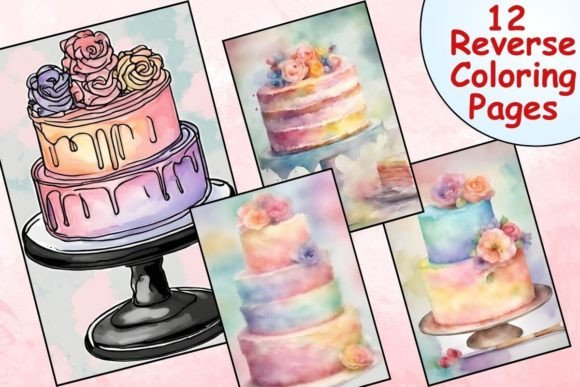
Delicious Cake Reverse Coloring Pages: A Sweet Creative Twist
Imagine a coloring book where the rules are flipped. Instead of staying inside pre-drawn lines with crayons, you hold the pen that defines the shape. This is the core appeal of Delicious Cake Reverse Coloring Pages, a digital download that transforms passive coloring into an active design exercise. By providing rich, watercolor-style cake backgrounds without outlines, these pages invite kids and adults to draw the contours themselves. It is a shift from filling space to creating structure, offering a refreshing break from traditional art activities.
For educators, parents, and creative professionals, this approach opens up a unique avenue for engagement. Whether you are looking for a classroom activity that demands focus or a relaxing evening hobby that stimulates the brain differently, reverse coloring provides a grounded yet imaginative solution. The pre-rendered backgrounds serve as a springboard, removing the intimidation of a blank page while leaving the artistic direction entirely in your hands.
Redefining the Artistic Process
The concept behind reverse coloring is deceptively simple but profoundly effective for skill development. In a standard coloring page, the cognitive load is on color selection and motor control within boundaries. With Delicious Cake Reverse Coloring Pages, the brain must first interpret the abstract blobs of color as three-dimensional objects. You decide where the frosting swirls end and where the cake layers begin. This requires a higher level of visual processing and spatial reasoning.
This method is particularly valuable for developing fine motor skills and hand-eye coordination. Drawing precise outlines over soft, blended backgrounds demands a steady hand and intentional movement. For young learners, this is an excellent way to practice line control without the frustration of complex freehand drawing. For adults, it acts as a form of mindfulness. The act of tracing imaginary edges over soothing colors can induce a flow state, reducing stress and promoting mental well-being after a long day of work.
Creative Applications for Different Audiences
The versatility of these pages means they fit seamlessly into various contexts, from early childhood education to professional design brainstorming.
- Educators and Teachers: Use these pages to teach concepts of shape, form, and pattern recognition. Ask students to identify different geometric shapes within the cake designs or to create patterns using the negative space. It turns an art lesson into a geometry exploration.
- Parents and Families: These pages are perfect for bonding moments. Unlike traditional coloring where everyone works silently on their own sheet, reverse coloring encourages conversation. "What kind of cake do you think this is?" or "Where should the cherry go?" becomes a collaborative storytelling session.
- Designers and Creatives: For professionals facing creative block, these pages offer a low-stakes environment to experiment with line weight and composition. Since the color palette is already established by the background, you can focus purely on the structural integrity of your lines.
- Therapists and Counselors: The open-ended nature of the activity allows for projective expression. How a person chooses to outline the chaotic colors can reveal insights into their current mindset, making it a useful tool for art therapy sessions focused on relaxation and self-expression.
Practical Project Ideas and Variations
To get the most out of your Delicious Cake Reverse Coloring Pages digital download, consider adapting the activity to suit specific goals or themes. The base material is flexible enough to support a wide range of projects beyond simple outlining.
Themed Birthday Parties: Instead of generic party favors, print these pages as part of a baking-themed birthday celebration. Provide guests with black fine-liner pens, metallic gel pens, or even white paint markers if printing on dark paper versions. Challenge them to design the "ultimate dream cake" based on the background provided. This keeps children engaged and results in unique artwork they can take home.
Mixed Media Experiments: Don't limit yourself to ink. Once you have drawn your outlines, you can add texture using collage elements, glitter glue, or embossing powder. The pre-drawn watercolor backgrounds pair beautifully with mixed media, allowing you to build depth and tactile interest. This approach is excellent for hobbyists looking to create greeting cards or framed wall art.
Digital Design Practice: If you are a digital artist, import these pages into your preferred tablet software. Use a stylus to trace over the backgrounds on a new layer. This allows you to experiment with different brush styles, opacity levels, and vector paths without ruining the original image. It is a safe sandbox for testing illustration techniques before applying them to client work.
Tips for Consistent and Clear Results
While the freedom of reverse coloring is its greatest strength, maintaining clarity in your final piece ensures the artwork remains visually appealing. Here are some practical recommendations to keep your results organized and professional:
- Choose the Right Tools: High-contrast pens work best against watercolor backgrounds. Black fineliners (0.5mm or 0.7mm) provide definition, while white gel pens pop beautifully against darker hues. Avoid pencils unless you intend to ink over them later, as graphite can muddy the vibrant background colors.
- Define Your Light Source: Even though you are drawing lines, thinking about lighting helps create volume. Decide where the light is coming from and make your outlines thicker on the shadowed sides of the cake layers or frosting swirls. This adds a subtle 3D effect to your 2D drawing.
- Embrace Imperfection: One of the biggest hurdles for adults trying new art forms is the fear of making mistakes. Remember that the charm of reverse coloring lies in its organic feel. Wobbly lines can mimic the texture of real whipped cream or handmade fondant. Let go of the need for geometric perfection.
- Layer Your Approach: Start with major structural lines—the edges of the cake tiers and the plate. Once the foundation is set, move on to decorative details like sprinkles, fruit toppings, or piping bags. Working from large to small prevents the design from becoming cluttered.
Unlocking Endless Possibilities
The Delicious Cake Reverse Coloring Pages collection is more than just a printable activity; it is a toolkit for cognitive flexibility and artistic exploration. By shifting the role of the user from colorist to architect, these pages challenge us to see potential in ambiguity. Whether used to quiet a restless classroom, spark a design idea, or simply unwind with a cup of tea, the value lies in the process of creation itself.
As you dive into these sugary designs, remember that there is no single correct way to complete the picture. Each outline you draw is a unique interpretation of the colors beneath. This freedom encourages confidence and fosters a mindset where creativity is accessible to everyone, regardless of age or skill level. So, pick up your pen, look at those soft blends of pink, blue, and vanilla, and start drawing the delicious world you imagine.